


The “Scenario Dilemma” in Solid Waste Processing: How to Select the Right Shredder?
China generates more than 10 billion tonnes of solid waste each year. However, material characteristics vary widely across application scenarios—municipal waste, industrial waste, bulky waste, and more.
Some streams contain high-moisture sticky materials, others are highly entangled, while some require precise particle sizes for RDF production.

1. Application Scenarios: Defining the Operating Boundaries
With 15 years of experience in solid waste processing, Harden has integrated German engineering concepts to develop a full range of single-shaft and dual-shaft shredders, designed to meet the core requirements of different waste treatment scenarios.

Rather than focusing solely on the “number of shafts”, this article examines practical application boundaries using tested equipment data and over 1,000 global project cases, providing clear and actionable guidance for shredder selection in solid waste processing.
2. Core Differences: The Application-Driven Design Logic
Single-Shaft Shredder: Precision Size Reduction for High-Value Recycling
Core model: One-Step Single-Shaft Shredder – SG Series
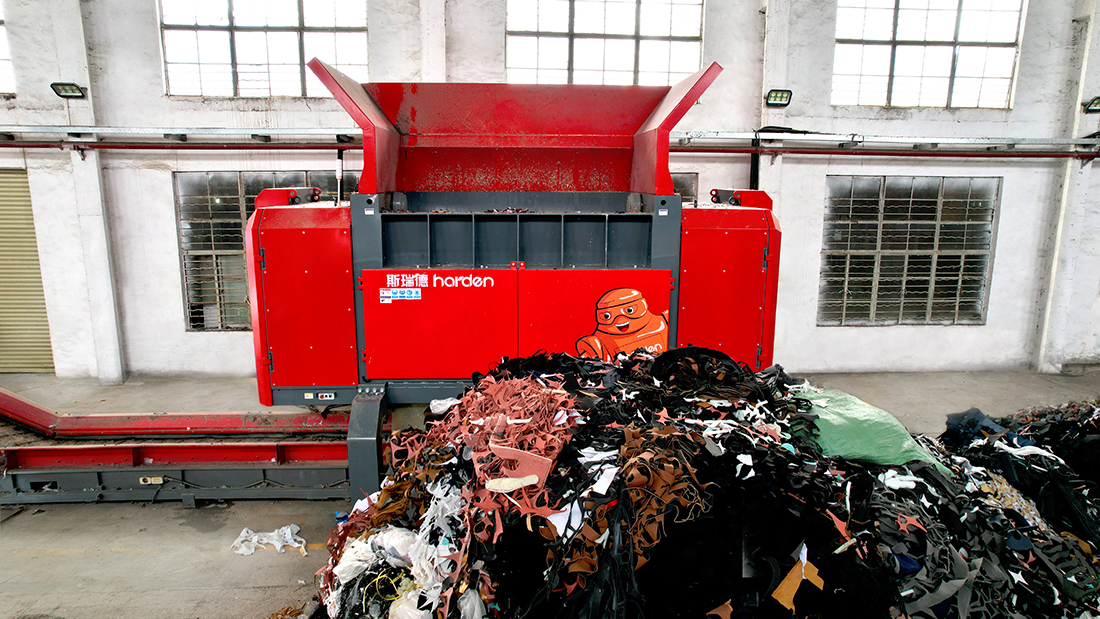
Key technical advantages
Multi-row angled cutter design combined with a high-speed rotor (800–1500 rpm) enables precise cutting of fibrous materials, effectively solving entanglement issues in textiles and biomass.
An intelligent hydraulic feeding system automatically matches rotor load, preventing material blockage and enabling one-step shredding of industrial waste and biomass to <50 mm.
Adjustable bottom screen (20–100 mm) combined with a PLC control system ensures up to 95% RDF particle size compliance, meeting the quality standards required by waste-to-energy plants.
Design philosophy:
Optimised for single-material streams requiring precise particle size, where high resource recovery efficiency is essential.
Dual-Shaft Shredder: Robust and Reliable for Mixed Waste Streams
Core model: Shear-Type Dual-Shaft Shredder
Key technical advantages
Two counter-rotating shafts (300–800 rpm) create a powerful shearing and tearing effect, delivering 60% higher torque than a single-shaft machine with equivalent power—ideal for bulky items such as solid wood furniture or spring mattresses.
Modular wear-resistant blades with clutch overload protection allow individual blade replacement. When processing construction waste or mixed waste containing metal contaminants, bearing service life can be extended by up to 50%.
Screen-free design, with output size controlled by blade spacing (10–80 mm), allows stable processing of high-moisture waste (≤60%) and complex mixed materials without clogging or downtime.
Design philosophy:
Built for complex materials and continuous operation, addressing the core challenges of volume reduction and pre-shredding in solid waste processing.
3. Selection Strategy: Three Steps to Identify the Right Solution
Step 1 – Analyse Material Characteristics
Homogeneous materials (plastic waste, leather scraps) with precise particle size requirements → Single-shaft shredder
Mixed waste streams containing metal, entangling materials, or high moisture → Dual-shaft shredder
Step 2 – Define the Processing Objective
RDF/SRF fuel production or high-purity recycling → Single-shaft shredder (controlled output size, higher recovery value)
Pre-shredding and volume reduction with stable continuous operation → Dual-shaft shredder (high impact resistance, low downtime)
Step 3 – Evaluate Lifecycle Cost
Small to medium projects (100–300 t/day) with limited installation space → Single-shaft shredder
10–15% lower initial investment
The footprint is only half that of a dual-shaft system
Large projects (100–800 t/day) under complex operating conditions → Dual-shaft shredder
20% lower maintenance cost
30% longer stable operating cycles
Conclusion: Precision vs. Versatility in Solid Waste Processing
The focus of modern waste treatment has evolved from simple size reduction to efficient resource recovery. The choice between single-shaft and dual-shaft shredders ultimately reflects two different operational strategies:
Maximum resource recovery:
For precise processing of homogeneous materials, the single-shaft shredder offers the most cost-effective solution.
Reliable pre-processing:
For complex and variable mixed waste streams, the dual-shaft shredder ensures stable and robust operation.
Combined volume reduction and recycling:
A two-stage shredding system can deliver synergistic performance beyond a single machine solution.
With over 1,000 solid waste processing projects worldwide, Harden provides not only equipment, but also tailor-made solutions based on your specific conditions—including material composition, capacity requirements, and resource recovery goals.

If you are evaluating a project, feel free to share your application details in the comments to receive a customised equipment selection report and real operational data.
