


The Profit Key to Waste Tyre Recycling: Get the Front-End Pre-Processing Right
Each year, around 18 million tonnes of waste tyres flow into the environment. The question repeatedly asked across the industry is simple:
Why is it still so difficult to turn waste tyres into valuable resources?
Why do many recycling projects meet environmental standards yet struggle to achieve profitability?
Why are downstream technologies—such as pyrolysis and reclaimed rubber—continuously improving, while returns still fall short of expectations?

The answer may lie in a step that is often underestimated: front-end pre-processing.
Without precise shredding and separation, even the most advanced pyrolysis reactor has little to work with.
Without a uniform particle size, the value of recovered materials declines.
Without stable throughput, the entire recycling chain becomes constrained.
Front-end pre-processing is far more than simply “cutting tyres into pieces”. It is the foundation that determines whether high-value utilisation can truly be achieved.
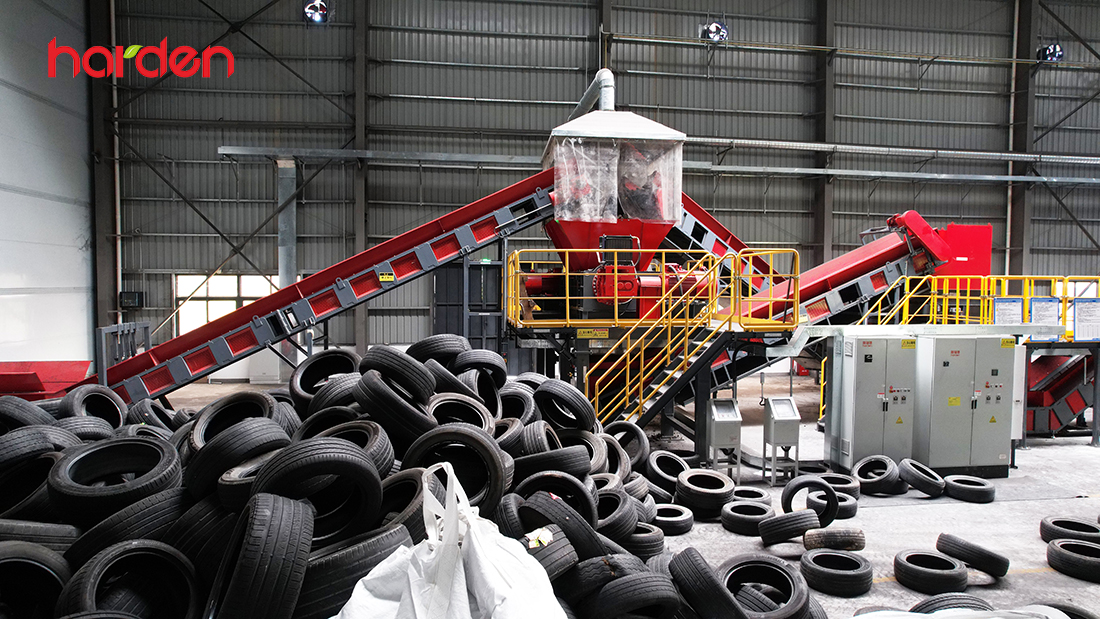
Whether tyres are processed for pyrolysis carbon black and pyrolysis oil, converted into TDF (Tyre-Derived Fuel), or used to produce rubber powder for modified asphalt, all downstream applications rely on stable, uniform, and high-purity feedstock.
Breaking the Bottleneck: Why Pre-Processing Determines Profitability
The essence of tyre recycling is precise value separation. Tyres consist of multiple materials—rubber, steel wire, fibre, and carbon black. The task of pre-processing is to achieve three key objectives with minimal loss:
1. Efficient size reduction
2. Accurate material separation
3. Consistent output quality
These three factors directly influence the quality grade, production capacity, and profitability of downstream products.
Traditional pre-processing systems often fall short due to their coarse and inefficient approach:
1. Insufficient capacity – conventional lines often process less than 3 t/h, limiting plant profitability.
2. Inconsistent particle size and incomplete separation – steel and fibre residues create instability in downstream processes, reducing product purity and lowering the market value of carbon black and pyrolysis oil.
3. Frequent blockages and high maintenance costs – rapid blade wear and machine downtime increase operational costs and extend ROI cycles.
To unlock the true value of waste tyre recycling, these front-end bottlenecks must be resolved first. Only with direct feeding of whole tyres, efficient fine shredding, and stable output quality can downstream technologies operate at their full potential.
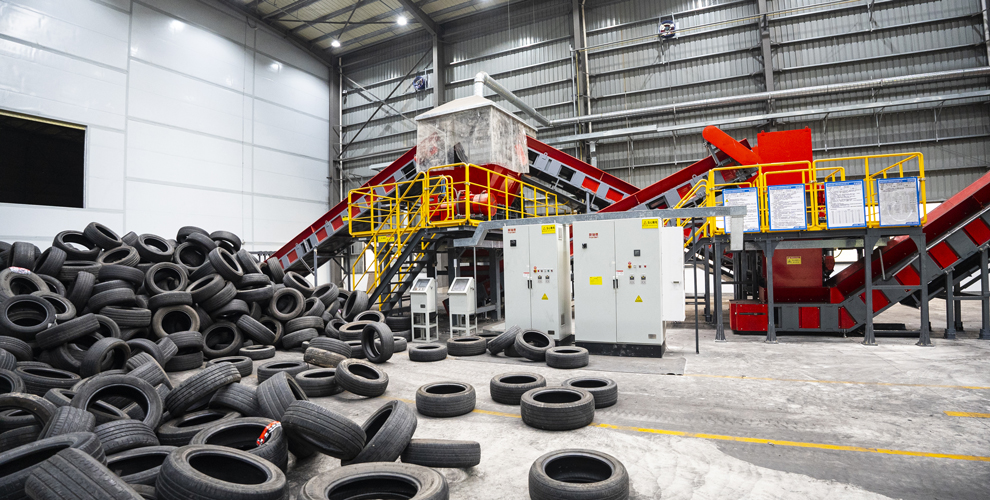
Harden’s Advanced Tyre Pre-Processing Technology
To address these industry challenges, the Harden engineering team conducted extensive market research and leveraged its expertise in precision shredding for solid waste processing. The result is a waste tyre pre-processing system built around the TD dual-shaft shredder.
Using a closed-loop shredding and screening process, the system can process whole tyres of various sizes and types without pre-removing the steel bead. Tyres are reduced into uniform rubber chips of approximately 50 mm, delivering:
✅ ≥5 t/h throughput per production line
✅ More than 95% compliance with the target particle size
This provides a stable and high-quality feedstock for downstream processes such as pyrolysis, TDF production, and rubber powder manufacturing.
Key Advantages
1. Increased capacity
A single production line can achieve 5–12 t/h, approximately 1.7–4 times higher than traditional systems, significantly improving plant productivity and reducing fixed costs per tonne.
2. Reduced wear and operating costs
High-strength alloy cutters combined with a low-energy shaft design minimise equipment wear and reduce blade replacement frequency, lowering overall maintenance costs.
3. Superior product consistency
The integrated recirculating shredding and precision screening process ensures uniform particle size and low impurity levels, stabilising downstream product quality and enabling higher market value.
A Flexible Front-End Solution for Multiple Applications
More importantly, the Harden system is not just a collection of machines, but a complete front-end solution adaptable to multiple recycling scenarios.
Without changing the core equipment, the system can flexibly process passenger car tyres, truck tyres, and other tyre types. Through customised system design, it can support various downstream value-added applications, including:
Feedstock preparation for pyrolysis plants
Standardised particle production for TDF fuel
High-quality base material for rubber powder modified asphalt
With stable and efficient pre-processing, downstream processes can focus on value creation. In essence, the front end determines the direction, while the back end maximises the value.
Waste tyre recycling has never been the responsibility of a single process—it requires coordination across the entire value chain. And within that chain, front-end pre-processing is the critical first step.

At Harden, we believe that only by building a strong foundation through advanced pre-processing technology can the recycling industry unlock the full potential of every waste tyre—enabling environmental protection and profitability to move forward together.
